
Marine and Vehicle Interiors: Specifying Birch Boards
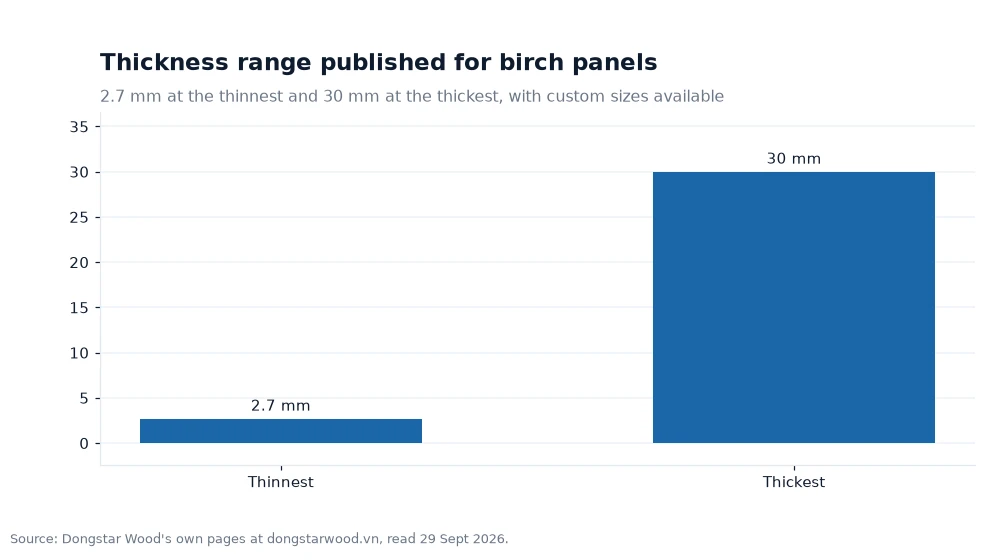
Specifying birch plywood for marine and vehicle interiors requires a panel that handles moisture, vibration and constant use without losing its shape or its finish. A Birch Plywood Supplier who publishes birch panels in thicknesses from 2.7 mm to 30 mm, with sizes ranging from 1220 × 2440 mm to 1250 × 3000 mm, gives the specifier the data needed to match the panel to the application. The multi-layer hardwood core construction is the foundation for panels that perform in confined, high-traffic spaces.

Key takeaways
- Birch thickness runs from 2.7 mm to 30 mm, with custom sizes available for marine and vehicle applications.
- Phenolic or melamine adhesives provide the moisture resistance that marine environments demand.
- The mill can issue E1, CARB P2 and CE certificates for both European and US-bound orders.
- Packing uses export-standard protective wrapping, steel strapping and wooden pallets for safe transit.
Why birch works in marine environments
Marine interiors face a combination of challenges that most building materials do not encounter together: constant moisture, temperature fluctuation, vibration from engines and waves, and the need for a finish that looks good under cabin lighting. Birch plywood addresses these challenges through its multi-layer construction, which distributes stress across alternating grain directions and resists the warping that single-direction panels develop under moisture cycling.
The published birch veneer face ranges from light cream to pale brown with a uniform grain structure, which is the aesthetic that yacht designers and vehicle interior specialists look for. The face accepts paints, stains, laminates and clear sealers, giving the interior designer the flexibility to match the panel to the overall cabin palette. For marine applications where the panel will be visible under a clear finish - bulkhead linings, cabinet faces, shelving - the uniform grain of birch provides a consistent backdrop that does not compete with other materials.
Thickness selection for cabinetry and structural use
Vehicle and marine interiors use panels across the full thickness range, and the choice depends on whether the panel is decorative, structural or both. Thin panels at 2.7 mm to 6 mm serve as backing panels, ceiling linings and decorative overlays where weight is the primary constraint. The light weight of thin birch makes it suitable for overhead installations where every kilogram affects the vehicle's centre of gravity or the vessel's trim.
At 9 mm to 12 mm, the panels handle cabinet construction, shelving and partition walls — the standard interior components of a boat cabin or a vehicle conversion. These thicknesses provide sufficient stiffness for daily use without adding excessive weight. At 18 mm and above, the panels become structural elements: worktops, heavy shelving, floor panels and load-bearing partitions. The published guidance places 18 mm as the standard choice for heavy-duty applications, and 21 mm for panels that must support concentrated loads.
Moisture resistance and adhesive selection
Marine environments demand moisture-resistant adhesives, and the published range covers E0, E1, E2, MR, WBP and Phenolic Dynea. For marine and vehicle interiors, WBP — Boiling Water Resistant — and Phenolic Dynea are the standard choices, because they maintain bond integrity under repeated wetting and drying cycles. Phenolic adhesives produce a dark glue line that is visible on the panel edge, which is acceptable in structural applications but may be undesirable in visible cabinetry where a lighter glue line is preferred.
Melamine adhesives are another option for marine interiors where moisture resistance is needed without the dark glue line. The buyer should specify the adhesive type at the point of order and confirm that the panel has been tested for the exposure conditions the application demands. For yacht interiors that will encounter occasional splash but not sustained immersion, MR or E1 may be sufficient; for engine rooms and bilge-adjacent compartments, WBP or Phenolic is the baseline.
Surface finish and the machining path
The panels are engineered for cutting, CNC routing, sanding and edge processing with minimal tear-out, the performance characteristic that matters most in marine interior work. Cabin components are often cut to complex shapes — curved bulkheads, angled shelves, notched partitions — and the panel must hold a clean edge across those cuts. The multi-layer hardwood core construction resists the lateral forces that cause tear-out on the face veneer, and the uniform grain structure reduces the risk of splintering during edge finishing.
For visible cabinetry, the face grade should be specified as A-grade or B-grade, depending on whether the surface will be clear-finished or painted. A-grade provides the cleanest face with minimal knots and burls, which suits clear-finished surfaces where every burl is visible. B-grade allows more surface variation, which is acceptable under paint or laminate where the face is covered.
| Application | Thickness range | Adhesive suggestion | Face grade |
|---|---|---|---|
| Ceiling linings, decorative overlays | 2.7–6 mm | E1 or MR | A-grade or B-grade |
| Cabinets, shelving, partitions | 9–12 mm | MR or WBP | A-grade or B-grade |
| Worktops, floor panels, structural | 18–21 mm | WBP or Phenolic Dynea | B-grade or C-grade |
| Engine rooms, bilge-adjacent | 12–18 mm | WBP or Phenolic Dynea | B-grade |
Worked example: panel weight for a cabin refit
A boat cabin refit requiring 40 panels of 600 mm × 400 mm at 12 mm thickness starts with the area calculation: each panel covers 0.6 m × 0.4 m = 0.24 m², and 40 panels cover 40 × 0.24 = 9.6 m². A standard birch sheet of 1220 × 2440 mm covers 2.98 m², so the order needs 9.6 ÷ 2.98 = 3.2 sheets, meaning 4 sheets minimum. At 12 mm thickness, each sheet weighs roughly 18 kg, and the total weight for 4 sheets is 4 × 18 = 72 kg — light enough for manual handling in a boatyard.
If the same programme uses 18 mm panels for the worktops and 9 mm panels for the ceiling linings, the buyer can optimise the order by specifying both thicknesses on the same purchase. The Birch Plywood page publishes the size and thickness options, and the Okoume Plywood page offers a lower-density alternative for overhead installations where weight is the primary constraint.
Frequently asked questions
Can birch plywood be used in engine rooms?
Birch plywood can be used in engine rooms when it is specified with WBP or Phenolic Dynea adhesive, which provides the moisture and heat resistance that engine-compartment environments demand. The panel should be sealed on all surfaces — faces and edges — to prevent moisture ingress, and the face grade can be B-grade or C-grade since the surface will not be visible.
What is the lightest birch panel suitable for ceiling linings?
The published thickness range starts at 2.7 mm, which is the lightest option for overhead installations. At 2.7 mm, the panel is suitable as a decorative overlay or backing panel where structural load is not a requirement. For ceiling panels that must support light fixtures or equipment, 6 mm provides more stiffness without adding significant weight.
Is a trial order subject to a minimum volume?
No. The capacity figure sets the upper limit of what leaves the yard each month, not the lower limit of an order. Interior fitters commonly place a short initial batch to confirm packing protection and panel flatness, then book a regular monthly allocation.
Specifying birch for your next marine or vehicle project
Marine and vehicle interior work is a specification exercise, not a commodity purchase. The panel must match the moisture conditions, the weight constraints and the finish requirements of the application. A Birch Plywood product page details the available sizes, thicknesses and face grades; a separate look at the company profile confirms the factory footprint and certification set ahead of any production commitment.
The measurements discussed were obtained from Dongstar Wood's product listings consulted on 29 September 2026[1].