
Can ViaBTC TX Accelerator Confirm Bitcoin Transactions Faster?
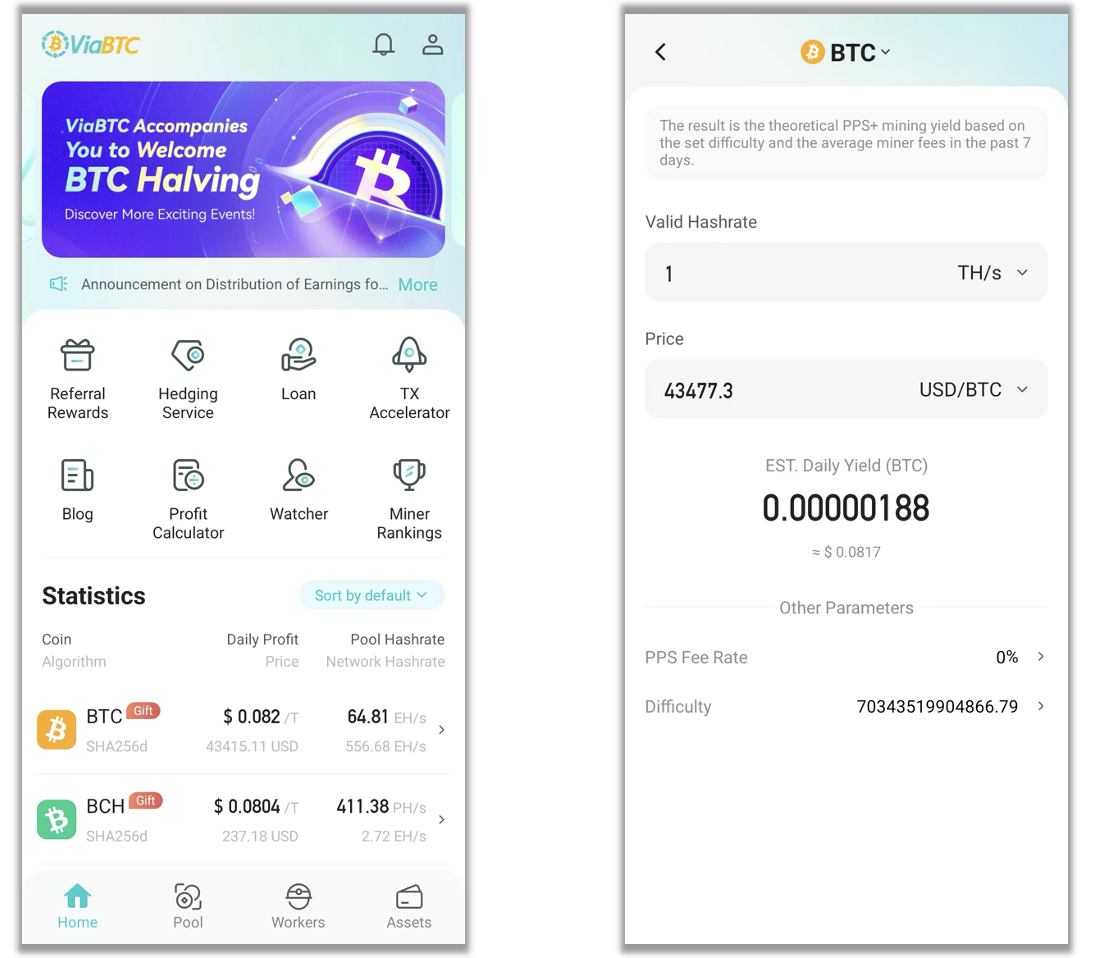
Yes. ViaBTC can shorten the waiting time for some unconfirmed Bitcoin transactions because its mining pool can give an accepted transaction higher priority when building a block candidate. As of 2026, ViaBTC’s live accelerator page requires free submissions to be no larger than 0.5 KB and to pay at least 0.0001 BTC/KB; its displayed free hourly quota can also change. Paid requests use a quoted acceleration fee and can be paid in BTC, BCH, or LTC. Acceleration improves the chance of earlier inclusion, but it cannot promise the next block, because Bitcoin block discovery remains probabilistic.
A Bitcoin transaction normally reaches one or more node mempools after broadcast and waits until a miner chooses it for a block. Miners do not have to process transactions in arrival order. They can construct blocks around fee economics and their own policies, so a transaction broadcast 30 minutes earlier can remain pending while newer transactions with better fee rates are mined first. Bitcoin’s block subsidy fell from 6.25 BTC to 3.125 BTC in the 2024 halving, a 50% reduction, making transaction fees an increasingly visible part of miner revenue alongside the subsidy.
That selection process explains why an accelerator can help without changing Bitcoin’s consensus rules. When an eligible TXID is submitted through the ViaBTC TX Accelerator, ViaBTC can mark the existing transaction for priority treatment inside its own block-building process. The sender does not create a new payment, and the accelerator does not increase Bitcoin’s block-production rate. ViaBTC’s current 2026 page says a successfully submitted free transaction is prioritized for the next block mined by ViaBTC.
Priority is not the same as a reservation in the next Bitcoin block. ViaBTC still has to mine a block before its transaction-selection preference can affect confirmation.
Bitcoin targets an average block interval of roughly 10 minutes, but individual intervals are not fixed at 10 minutes. One block may arrive much sooner, while another may take considerably longer. A pool responsible for 10% of block production over a sufficiently large period would be expected to produce roughly 10% of blocks, not every tenth block on a fixed schedule. Mining uses probabilistic proof-of-work, so an accelerator can change transaction selection but cannot schedule the moment a participating pool discovers a valid block.
The transaction fee itself also needs to be read correctly. Bitcoin wallets commonly describe fees through satoshis per virtual byte, while ViaBTC publishes the free-service threshold as 0.0001 BTC/KB. Since 1 BTC contains 100,000,000 satoshis, 0.0001 BTC equals 10,000 satoshis. The exact comparison with wallet fee displays needs care because transaction weight, virtual size, and ViaBTC’s stated KB measurement are not interchangeable in every context. Its published 2026 eligibility test should therefore be checked against the service page rather than estimated from the total fee alone.
| Item | ViaBTC published condition |
|---|---|
| Free transaction size | ≤ 0.5 KB |
| Free minimum fee rate | ≥ 0.0001 BTC/KB |
| Information required | TXID |
| Paid-service payment | BTC, BCH, or LTC |
| Cancellation after submission | Not supported |
| Refund after submission | Not supported |
| Double-spend acceleration | Not supported |
ViaBTC’s older Help Center article, updated in 2024, states that the service offered 20 free acceleration opportunities per hour. The live service page visible in 2026 currently displays 0 free accelerations per hour. The difference matters because a fixed figure copied from an older guide can become inaccurate even when the size and fee requirements remain unchanged. Anyone planning to use the free service should treat the live hourly count as the current operating number rather than assume that 20 places are always available.
Paid acceleration changes the service arrangement rather than the transaction’s original outputs. ViaBTC asks for the TXID, calculates an acceleration charge, accepts payment, and then gives the transaction priority treatment. Its 2024 Help Center documentation also says cooperating mining pools can be notified for paid acceleration, allowing the transaction to be selected when a participating pool produces a block. The current public service page uses simpler wording, stating that ViaBTC prioritizes packaging after payment. Neither description turns confirmation into a fixed-time service.
Transaction dependencies can make the result less straightforward. Suppose Transaction B spends an output created by Transaction A while A still has zero confirmations. B cannot be mined independently without the parent because the output it spends does not yet exist in the confirmed chain. ViaBTC lists an unconfirmed previous transaction as one reason a free acceleration request can fail and recommends addressing the earlier transaction first or considering the paid route. A user who only checks B’s fee may therefore miss the parent transaction that is holding the chain of payments back.
Bitcoin Core’s mempool rules have also become more package-aware. Bitcoin Core 31.0, released in 2026, introduced cluster-based mempool ordering and changed replacement handling so that a replacement must improve the mempool’s fee-rate diagram. For a standalone transaction, the replacement generally needs both a higher absolute fee and a higher fee rate than the original. Miners running different software can still apply their own policies, but the direction is clear: transaction selection involves more than comparing one isolated fee number against another.
That matters when comparing acceleration with Replace-by-Fee. RBF creates a replacement transaction that pays more and can therefore compete more effectively for block space. Because a replacement changes the transaction itself, it normally produces a new TXID. ViaBTC acceleration takes another route: it asks a participating miner to prioritize the transaction that already exists. For a wallet that offers usable fee replacement, RBF may provide wider exposure because miners across the network can evaluate the higher-fee replacement rather than depending on one accelerator arrangement.
CPFP provides another alternative when the recipient or sender controls a spendable output from the unconfirmed transaction. A higher-fee child can raise the economic attractiveness of mining the parent and child together. The useful comparison is package cost: if a parent effectively contributes 2 sat/vB and the child pays enough to bring the combined package to a competitive rate, a miner may include both. Bitcoin Core’s 2026 mempool changes further formalized package and cluster treatment, so evaluating related transactions together is part of modern transaction handling.
The accelerator becomes more useful when neither fee-bumping method is practical. A sender may have used a custodial withdrawal system that does not expose RBF controls, or the transaction may contain no output that the person trying to speed it up can conveniently spend through CPFP. In those cases, submitting an existing TXID requires less wallet-level control. ViaBTC has operated its mining service since 2016 and says its broader mining platform serves more than 1 million users across 150+ countries and regions, so the accelerator is attached to an operating mining-pool business rather than a stand-alone transaction webpage.
There are still several conditions that an accelerator cannot repair:
-
A wrong TXID cannot be accelerated simply by resubmitting it.
-
A transaction that has not propagated far enough may not be found by the service.
-
A free request above 0.5 KB falls outside ViaBTC’s published free-size rule.
-
A fee below 0.0001 BTC/KB falls outside its published free fee rule.
-
A transaction spending an unconfirmed input may require the parent to be handled first.
-
ViaBTC states that double-spend transactions are not supported.
Transaction size deserves extra attention because 0.5 KB leaves limited room for complex input structures. A transaction spending several old UTXOs can be much larger than a simple payment spending one input, even when both send the same BTC amount. More inputs require more transaction data, while modern SegWit structures can reduce effective weight compared with older formats. Two people transferring 0.01 BTC can therefore create transactions with very different sizes and fee requirements; the BTC amount alone says little about whether the 0.5 KB free-service ceiling will be met.
Cost also changes the practical comparison. A paid accelerator fee should be compared with the amount being transferred, the urgency of confirmation, and the price of using a wallet-level fee bump where available. Paying the equivalent of $30 to speed up a $200 transfer adds 15% to the economic cost, while the same $30 on a $20,000 transfer adds only 0.15%. Those percentages are examples rather than ViaBTC prices because the paid service supplies an estimated charge for the submitted transaction instead of publishing one permanent fee for every TXID.
Security requirements are simpler. A legitimate accelerator only needs public transaction information such as a TXID and, for paid service, the information required to complete payment. A TXID does not grant control of the Bitcoin being spent. A seed phrase or private key does. No transaction-acceleration request requires giving a mining pool a wallet seed phrase or private key. In 2026, users should enter transaction information only on the official service and reject any page or message asking for wallet recovery words as a condition of confirmation.
Waiting can still be reasonable when the transaction already pays a competitive fee. Mempools change as blocks clear pending transactions and new transfers arrive. A transaction sitting below the preferred range at one hour can become mineable later without any alteration if demand falls. Acceleration has the strongest use case when waiting has a real cost, the original transaction is valid, the fee is not getting it mined soon enough, and the available wallet does not offer a cheaper fee-bumping route.
The practical test is therefore based on observable transaction data rather than the number of minutes already spent waiting. Check whether the TXID is visible, whether any parent remains unconfirmed, the transaction size, the original fee rate, current fee competition, and whether RBF or CPFP is available. Then compare those conditions with ViaBTC’s current service rules. In 2026, free eligibility still lists ≤0.5 KB and ≥0.0001 BTC/KB, while free hourly availability is shown separately and can change.
ViaBTC TX Accelerator can make a valid, low-priority Bitcoin transaction more likely to reach a block sooner because participating miners can select it ahead of the position it would receive under ordinary fee competition. The service has more influence when the participating pool finds a block soon after submission and less when other miners produce several consecutive blocks. A successful submission should therefore be understood as preferential transaction handling, not a 100% guarantee of confirmation in the next block or within a fixed number of minutes.